
Can Your Tree Plantation Earn Carbon Credits in India? The CCTS Offset Mechanism, Explained for 2026
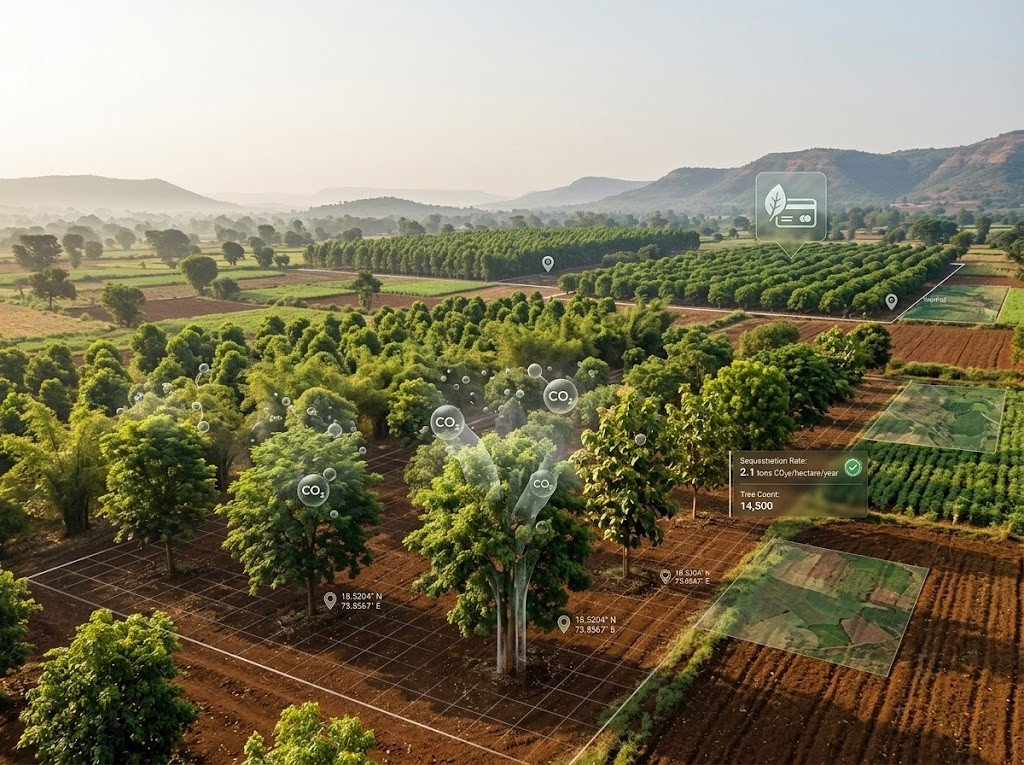
Every plantation pitch deck in India now has a carbon credits slide.Most of them are wrong. The pitch usually goes: plant trees, sequester carbon, earn credits,sell credits, project pays for itself. It sounds clean. It ignores roughly four years of regulatory process, aset of integrity tests that most plantation drives fail on the firstone, and the inconvenient fact that as of 2026, afforestation onordinary land is not yet an approved methodology under India’scompliance carbon market. This is an honest walkthrough of what India’s Carbon Credit TradingScheme actually is, where tree plantation fits, where it doesn’t, andwhat to build now so you are positioned when the framework widens. WHAT CCTS IS, IN PLAIN TERMS India’s Carbon Credit Trading Scheme (CCTS) is the country’s firstlegislated compliance carbon market. It was introduced through theEnergy Conservation (Amendment) Act, 2022 and notified in June 2023. It replaces the older Perform, Achieve and Trade (PAT) scheme, whichtracked energy consumption, with a system that tracks actual greenhousegas emission intensity. It runs on two tracks. TRACK ONE — THE COMPLIANCE MARKET Around 740 entities across nine energy-intensive sectors are assignedGreenhouse Gas Emission Intensity (GEI) targets by the Bureau of EnergyEfficiency. Beat your target, and you earn Carbon Credit Certificates (CCCs), eachrepresenting one tonne of CO₂ equivalent. Miss it, and you buy CCCs from the market and surrender them. The penalty for non-compliance is twice the average CCC market price perunit of shortfall. The first compliance deadline is 31 July 2026, for FY 2025-26. First trading on regulated power exchanges is expected from roughlyOctober 2026, under CERC’s Carbon Credit Certificate Regulations, 2026. TRACK TWO — THE OFFSET MECHANISM This is the part that matters for plantation. Entities not covered by compliance targets can register eligibleprojects, get verified emission reductions or removals, and earntradable CCCs. The ICM portal opened for voluntary registration in June 2025. THE ARCHITECTURE: WHO DOES WHAT? The CCTS framework is divided across several institutions: THE UNCOMFORTABLE PART: WHAT’S ACTUALLY APPROVED? BEE has approved a set of offset methodologies. As of 2026 they cover: Read that last line carefully. Mangrove afforestation. Not general afforestation. Not agroforestry on farmland. Not urban greening. Not native-species reforestation on degraded upland. There is a further gate: projects must have a start date no earlier than1 January 2025. A plantation you did in 2022 is not coming back to life as a credit. So the direct answer to the headline question, for most Indian corporateplantation programmes today: NO, NOT YET, NOT UNDER CCTS. Broader afforestation, reforestation and improved forest managementmethodologies — the REDD+-aligned family — are widely expected in latertranches, and forestry is explicitly named among the sectors the offsetmechanism is designed to bring in. But “expected” is not “notified,” and any consultant telling youotherwise is selling a timeline they do not control. THE FIVE TESTS EVERY OFFSET PROJECT HAS TO PASS Whenever forestry methodologies do widen, the integrity principles willnot change. BEE-approved methodologies must satisfy five core requirements, drawingheavily on UNFCCC CDM, Gold Standard and Verra VCS practice, adapted forIndian conditions. Here is what each one means when the project is trees, and whyplantation projects fail them. Would this have happened anyway? If the plantation was going to occur regardless — because it was astatutory compensatory afforestation obligation, a state governmentdrive, or a CSR spend the company was legally required to make — thecarbon benefit is not additional. This is the sharpest edge for Indian corporates, and almost nobodyaddresses it upfront. CSR-funded plantation has a genuine additionality problem, because thespend is mandated under Section 135. You need a defensible argument that the specific project would not havehappened at this scale, on this land, without the carbon revenue. Sometimes that argument exists. Often it does not. Carbon in a tree is reversible. Fire, felling, disease, drought, land-use change — any of these releaseit back. Forestry methodologies handle this through long crediting periods,buffer pools where a percentage of credits is withheld against reversalrisk, and legally binding land-tenure commitments that outlast thepeople who signed them. Practically: if you cannot demonstrate secure rights over the land forthe full crediting period, you cannot claim permanence. A handshake with a farmer is not a land tenure instrument. Emission removals must be quantified against a defined baseline using anapproved methodology — not estimated with a rule of thumb. The number of forestry carbon claims in India derived from multiplyingsapling count by a generic per-tree sequestration figure is genuinelystartling, and none of it would survive a validation body. Real measurement means baseline biomass, allometric equationsappropriate to the species and region, soil organic carbon where themethodology requires it, and a monitoring plan with stated samplingintensity and uncertainty bounds. If protecting or planting on one parcel simply pushes grazing, fuelwoodcollection or cultivation onto the next parcel, you have moved theemissions, not removed them. Leakage assessment is mandatory and it is where community engagementstops being a nice-to-have and becomes a technical requirement. A plantation that displaces existing livelihoods generates leakagealmost by definition. One tonne, one claim. You cannot count the same removal against a green credit, a CCC, avoluntary market credit and your BRSR disclosure simultaneously. With India now running CCTS, the Green Credit Programme andvoluntary-market activity in parallel, double counting risk is high andrising. There is an international layer too. Under Article 6 of the Paris Agreement, credits sold to a foreign buyerfor use against their national target require a corresponding adjustmentby India — meaning India adds that tonne back to its own NDC accounting. This is precisely why India restricted exports of certain credit types. If your revenue model assumes selling Indian forestry credits into aninternational compliance buyer, model the corresponding adjustment riskbefore you model the revenue. WHAT THE PIPELINE ACTUALLY LOOKS LIKE For anyone assuming credits arrive shortly after the saplings do — thereal sequence is: Typical timeline from project development to first issuance: 12 to 24months — and that assumes the project is on an approved methodology fromday one. For forestry specifically, the monitoring period itself is theconstraint. Trees need years of growth before there is measurable