
Tree Plantation Survival Rates in India: Why Most Corporate Drives Fail, and What Geo-Tagged Monitoring Changes

There is a specific kind of photograph that circulates every June. A row of people in branded t-shirts, spades held at an angle, a line ofsaplings in fresh pits, a banner with a number on it. The number is always the count of saplings planted. It is never thecount of trees alive. That gap — between planted and alive — is the entire subject of thisarticle. Because it is not a small gap. Survival rates for Indian plantationdrives, where they have been independently audited at all, frequentlyland somewhere between 30% and 60% at the three-year mark, and theprojects that do worse are usually the ones that never measured. The good news: almost every cause of mortality is known, predictable andfixable. What has been missing is not the knowledge. It is the accountabilitystructure that makes anyone act on it. WHAT “SURVIVAL RATE” ACTUALLY MEANS — AND WHY THE NUMBER IS USUALLYMEANINGLESS Before diagnosing the problem, fix the metric. A survival rate quoted without three qualifiers is not data. Survival at 3 months is a nursery statistic. Survival at 12 months tells you whether the sapling made it through onedry season. Survival at 3 years tells you whether you have a tree. Survival at 5 years tells you whether you have a forest. These are wildly different numbers for the same plot, and unscrupulousreporting picks the earliest one. The regulatory direction has settled this argument. The Green Credit Programme’s revised modalities, notified in August2025, require a minimum of five years of restoration activity beforecredits are issued, calculated on vegetation status including change incanopy density after achieving a minimum of 40% and the number ofsurviving trees. Five years and canopy — not saplings and photographs. Did someone count every tree, or sample plots and extrapolate? Both are legitimate. Census is honest at small scale; stratified random sampling is standardabove a few thousand trees. What is not legitimate is walking the easiest edge of the plot andgeneralising. The methodology must be stated. A sapling with green leaves and a sapling that has established a rootsystem deep enough to survive the next summer are different things. Serious protocols record height and, once trees are large enough,diameter at breast height — not just presence. If a plantation report gives you a percentage without these three, it ismarketing. WHY THEY DIE: THE EIGHT FAILURE MODES The single largest cause. Species selection driven by nursery availability or cost per saplingrather than by soil, rainfall and local ecology. Site-species matching means matching the plant to: A species that thrives in coastal Maharashtra will not survive on alateritic plateau in Jharkhand, however cheap the sapling was. Native species are usually the answer — not for ideological reasons, butbecause they are already adapted to local rainfall patterns, soilchemistry and pest pressure, and they support existing pollinator andbird populations. Exotic fast-growers look impressive at year two and frequently leave youwith a monoculture that provides poor biodiversity value and, on somesites, depletes groundwater. In most of India, the planting window is the onset of the monsoon. Planting into the first reliable rains gives the sapling a full wetseason to establish roots before facing its first dry period. Plant in October and you have handed a fresh transplant six months ofdrought. Plantation drives scheduled around World Environment Day (5 June),corporate calendars, or the visiting dignitary’s availability ratherthan the actual local monsoon onset kill saplings on the calendar alone. Pits dug too small, too shallow, or backfilled with the same compactedsoil that was removed. A pit should be dug well in advance where possible, allowing weathering,and backfilled with a mix of topsoil, organic matter and, whereindicated, soil amendments. In hard or rocky substrate, pit dimensions matter more, not less. A tall sapling in a small polybag is often root-bound — the root systemhas coiled inside the container and will not spread properly aftertransplant. Root-bound stock has high early mortality that looks like drought damageand gets blamed on weather. Stock should be assessed on root-to-shoot balance and hardening-off, noton height. This is the structural failure. Budgets are almost always built around the planting event. Watering through the first two dry seasons, weeding cycles, replacementof casualties, protection maintenance and soil work in years two andthree are where survival is actually determined — and where nobodyallocated money. A useful discipline: If the maintenance budget is less than the planting budget, the projectis designed to fail. Grazing is the second-largest cause of mortality in most Indianlandscapes. Free-ranging cattle and goats will remove a plantation in a fortnight. Tree guards, trench-and-mound, or live fencing add cost — and skippingthem makes the entire spend a donation to livestock. Trees planted by outsiders, on land nobody local benefits from, get noinformal protection. Trees that a village, a farmer or a school has a stake in acquire ahundred unpaid guardians. This is not sentiment — it is the cheapest protection mechanismavailable, and it is why agroforestry models with an income streamattached consistently outperform pure plantation on survival. The failure that hides all the others. If nobody measures survival at 12 and 36 months, nobody knows whichspecies failed, which site conditions caused it, or which contractorunder-delivered. The mistakes repeat, at scale, every year. THE MEASUREMENT STACK: WHAT “GEO-TAGGED” SHOULD ACTUALLY MEAN “Geo-tagged plantation” has become a marketing phrase. Here is what a real monitoring architecture contains. LAYER 1 — SPATIAL IDENTITY Every plot gets a boundary polygon captured by GPS. Within it, each sapling or each planting row gets a coordinate with anaccuracy figure recorded. Consumer smartphone GPS delivers roughly 3–5 metre accuracy in openconditions, which is adequate at plot level. Sub-metre sapling-level identification needs either differential GPS ora physical identifier tied to a coordinate. That physical identifier is what a QR code does. Not magic — just a durable, scannable link between a specific tree and aspecific database record, so that a field auditor two years later isverifying this tree, not a tree in roughly this area. LAYER 2 — BASELINE Date-stamped, georeferenced photographs of the site before planting. Soil condition, existing
Can Your Tree Plantation Earn Carbon Credits in India? The CCTS Offset Mechanism, Explained for 2026
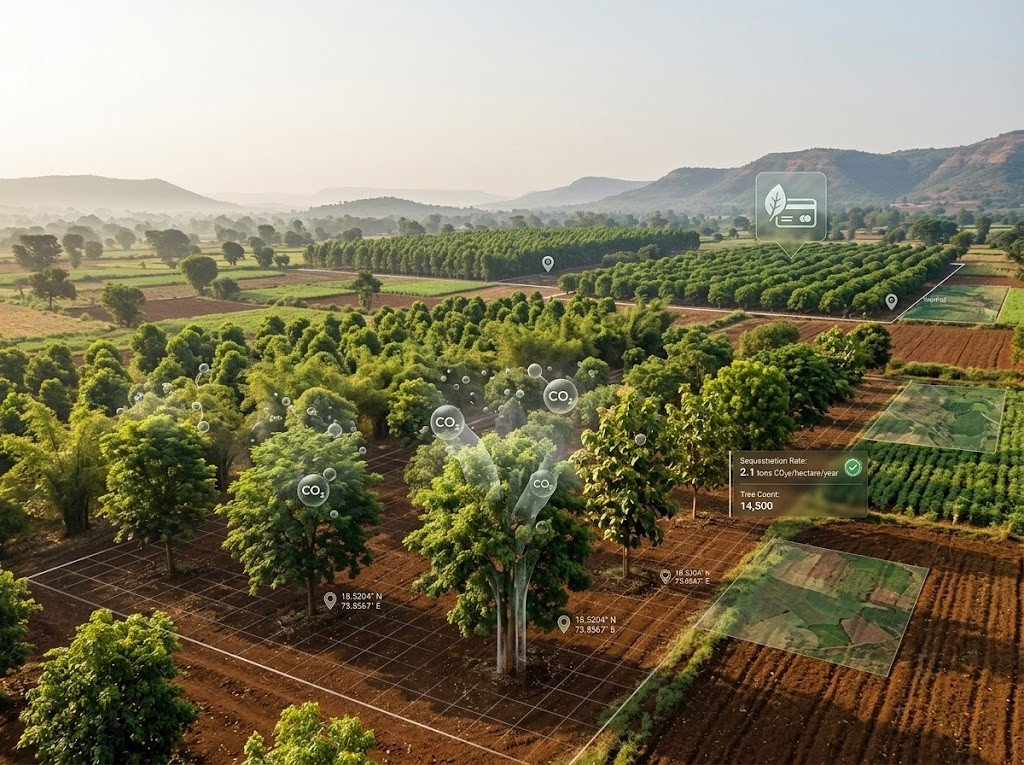
Every plantation pitch deck in India now has a carbon credits slide.Most of them are wrong. The pitch usually goes: plant trees, sequester carbon, earn credits,sell credits, project pays for itself. It sounds clean. It ignores roughly four years of regulatory process, aset of integrity tests that most plantation drives fail on the firstone, and the inconvenient fact that as of 2026, afforestation onordinary land is not yet an approved methodology under India’scompliance carbon market. This is an honest walkthrough of what India’s Carbon Credit TradingScheme actually is, where tree plantation fits, where it doesn’t, andwhat to build now so you are positioned when the framework widens. WHAT CCTS IS, IN PLAIN TERMS India’s Carbon Credit Trading Scheme (CCTS) is the country’s firstlegislated compliance carbon market. It was introduced through theEnergy Conservation (Amendment) Act, 2022 and notified in June 2023. It replaces the older Perform, Achieve and Trade (PAT) scheme, whichtracked energy consumption, with a system that tracks actual greenhousegas emission intensity. It runs on two tracks. TRACK ONE — THE COMPLIANCE MARKET Around 740 entities across nine energy-intensive sectors are assignedGreenhouse Gas Emission Intensity (GEI) targets by the Bureau of EnergyEfficiency. Beat your target, and you earn Carbon Credit Certificates (CCCs), eachrepresenting one tonne of CO₂ equivalent. Miss it, and you buy CCCs from the market and surrender them. The penalty for non-compliance is twice the average CCC market price perunit of shortfall. The first compliance deadline is 31 July 2026, for FY 2025-26. First trading on regulated power exchanges is expected from roughlyOctober 2026, under CERC’s Carbon Credit Certificate Regulations, 2026. TRACK TWO — THE OFFSET MECHANISM This is the part that matters for plantation. Entities not covered by compliance targets can register eligibleprojects, get verified emission reductions or removals, and earntradable CCCs. The ICM portal opened for voluntary registration in June 2025. THE ARCHITECTURE: WHO DOES WHAT? The CCTS framework is divided across several institutions: THE UNCOMFORTABLE PART: WHAT’S ACTUALLY APPROVED? BEE has approved a set of offset methodologies. As of 2026 they cover: Read that last line carefully. Mangrove afforestation. Not general afforestation. Not agroforestry on farmland. Not urban greening. Not native-species reforestation on degraded upland. There is a further gate: projects must have a start date no earlier than1 January 2025. A plantation you did in 2022 is not coming back to life as a credit. So the direct answer to the headline question, for most Indian corporateplantation programmes today: NO, NOT YET, NOT UNDER CCTS. Broader afforestation, reforestation and improved forest managementmethodologies — the REDD+-aligned family — are widely expected in latertranches, and forestry is explicitly named among the sectors the offsetmechanism is designed to bring in. But “expected” is not “notified,” and any consultant telling youotherwise is selling a timeline they do not control. THE FIVE TESTS EVERY OFFSET PROJECT HAS TO PASS Whenever forestry methodologies do widen, the integrity principles willnot change. BEE-approved methodologies must satisfy five core requirements, drawingheavily on UNFCCC CDM, Gold Standard and Verra VCS practice, adapted forIndian conditions. Here is what each one means when the project is trees, and whyplantation projects fail them. Would this have happened anyway? If the plantation was going to occur regardless — because it was astatutory compensatory afforestation obligation, a state governmentdrive, or a CSR spend the company was legally required to make — thecarbon benefit is not additional. This is the sharpest edge for Indian corporates, and almost nobodyaddresses it upfront. CSR-funded plantation has a genuine additionality problem, because thespend is mandated under Section 135. You need a defensible argument that the specific project would not havehappened at this scale, on this land, without the carbon revenue. Sometimes that argument exists. Often it does not. Carbon in a tree is reversible. Fire, felling, disease, drought, land-use change — any of these releaseit back. Forestry methodologies handle this through long crediting periods,buffer pools where a percentage of credits is withheld against reversalrisk, and legally binding land-tenure commitments that outlast thepeople who signed them. Practically: if you cannot demonstrate secure rights over the land forthe full crediting period, you cannot claim permanence. A handshake with a farmer is not a land tenure instrument. Emission removals must be quantified against a defined baseline using anapproved methodology — not estimated with a rule of thumb. The number of forestry carbon claims in India derived from multiplyingsapling count by a generic per-tree sequestration figure is genuinelystartling, and none of it would survive a validation body. Real measurement means baseline biomass, allometric equationsappropriate to the species and region, soil organic carbon where themethodology requires it, and a monitoring plan with stated samplingintensity and uncertainty bounds. If protecting or planting on one parcel simply pushes grazing, fuelwoodcollection or cultivation onto the next parcel, you have moved theemissions, not removed them. Leakage assessment is mandatory and it is where community engagementstops being a nice-to-have and becomes a technical requirement. A plantation that displaces existing livelihoods generates leakagealmost by definition. One tonne, one claim. You cannot count the same removal against a green credit, a CCC, avoluntary market credit and your BRSR disclosure simultaneously. With India now running CCTS, the Green Credit Programme andvoluntary-market activity in parallel, double counting risk is high andrising. There is an international layer too. Under Article 6 of the Paris Agreement, credits sold to a foreign buyerfor use against their national target require a corresponding adjustmentby India — meaning India adds that tonne back to its own NDC accounting. This is precisely why India restricted exports of certain credit types. If your revenue model assumes selling Indian forestry credits into aninternational compliance buyer, model the corresponding adjustment riskbefore you model the revenue. WHAT THE PIPELINE ACTUALLY LOOKS LIKE For anyone assuming credits arrive shortly after the saplings do — thereal sequence is: Typical timeline from project development to first issuance: 12 to 24months — and that assumes the project is on an approved methodology fromday one. For forestry specifically, the monitoring period itself is theconstraint. Trees need years of growth before there is measurable
CSR Tree Plantation in India: What Actually Qualifies Under Schedule VII in 2026

Most corporate tree plantation projects in India are not killed bydrought. They are killed by an auditor asking one question: where is theproof? A company writes a cheque. An NGO plants saplings. Someone from the CSRteam flies down, holds a spade for a photograph, and the LinkedIn postgoes up by evening. Eighteen months later the statutory auditor asks forthe geo-coordinates, the species list, the survival data and theimplementing agency’s CSR-1 registration number, and nobody in the roomhas any of it. That is not a plantation problem. That is a documentation problem — andin 2026, with the Ministry of Corporate Affairs tightening itsinterpretation of what a defensible CSR project looks like, it hasbecome an expensive one. This piece breaks down exactly where tree plantation sits in India’s CSRlaw, what makes a project eligible, and what your file needs to containbefore an auditor opens it. FIRST: DOES TREE PLANTATION EVEN COUNT AS CSR? Yes — and the basis is narrower than most people assume. CSR-eligible activity in India is not defined by good intentions. It isdefined by Schedule VII of the Companies Act, 2013, a closed list ofcategories read together with MCA circulars. Tree plantation falls under item (iv) — ensuring environmentalsustainability, ecological balance, protection of flora and fauna,animal welfare, agroforestry, conservation of natural resources andmaintaining quality of soil, air and water. Three things follow from that wording, and each one has tripped up realcompanies: This matters. A plantation programme that puts fruit-bearing ormedicinal species on farmer land, with an income stream attached, sitssquarely inside Schedule VII. It is not a stretched interpretation. MCA’s consistent position is that there must be a direct, defensiblelink between the activity and the Schedule VII category. Landscaping the corporate campus does not survive this test. Plantinginside a factory boundary primarily for aesthetics does not either — andif the benefit accrues mainly to employees, it is disqualified outright,because CSR cannot be spent on activities carried out exclusively foremployees and their families. If you are a nursery, a timber company or a landscaping firm, plantationis your business, not your CSR. WHO IS ACTUALLY LIABLE? CSR applies to any company — private, public, listed, unlisted, Section8, or the Indian arm of a foreign parent — that crosses any one of threethresholds in the immediately preceding financial year: Cross one, and the obligation triggers: spend at least 2% of the averagenet profits of the three immediately preceding financial years,calculated under Section 198 of the Act — not under the Income Tax Act. That distinction alone accounts for a fair number of computation errors. Worth watching: the Companies (Amendment) Bill, 2025, still pending,proposes pulling those thresholds down to ₹100 crore net worth, ₹500crore turnover and ₹3 crore net profit. If it passes in its current form, a large band of mid-market Indiancompanies enters the CSR net for the first time — most of them withoutan in-house CSR function. THE FOUR DOCUMENTS THAT DECIDE WHETHER YOUR SPEND SURVIVES AUDIT Here is where plantation projects actually fail. Not in the field. Inthe file. If you are routing CSR spend through an NGO, trust, society or Section 8company, that entity must be registered with the MCA via Form CSR-1 andhold a valid CSR Registration Number. This has been mandatory since 1April 2021. No CSR-1, no valid spend. It is that binary. Ask for the CSRN before thefirst tranche leaves your account, and put it in the agreement. The CSR Committee must formulate, and the Board must approve, an AnnualAction Plan specifying the list of projects, the manner of execution,modalities of fund utilisation, and — critically — the monitoring andreporting mechanism. For a plantation project, “monitoring mechanism” cannot read “periodicreview by the CSR team.” That is what a weak file looks like. A strongone names the survival audit schedule, the verification method, and whosigns off. Form CSR-2 is the annual CSR report filed with the MCA, submittedthrough the V3 portal, and it requires project-level disclosure — not alump-sum environment number. Project name, location, duration, amount spent, implementing agency andCSRN, mode of implementation. If your plantation project cannot be described at that granularity, itcannot be filed cleanly. Companies with an average CSR obligation of ₹10 crore or more over thethree immediately preceding financial years must have qualifyingprojects assessed by an independent agency. The assessment report goesto the Board and is annexed to the annual CSR report. An impact assessor evaluating a tree plantation project will ask forbaseline land condition, species-wise planting records, survivalpercentage against a defined measurement window, and evidence ofcommunity involvement. If the only artefact is an invoice for “50,000 saplings,” the assessmentwill say so in writing, and that document becomes part of your permanentrecord. TWO STRUCTURAL CHOICES THAT QUIETLY DECIDE EVERYTHING STRUCTURE IT AS AN “ONGOING PROJECT” An ongoing project is a multi-year project with a duration not exceedingthree financial years, excluding the year of commencement, and it mustbe identified as such by the Board. This is the single most useful structuring decision available to aplantation programme, for a simple reason: trees do not become anoutcome in twelve months. A one-year plantation project forces you to report success at the exactmoment when survival data is least meaningful. A three-year ongoingproject lets you fund planting in Year 1 and maintenance, replacementand survival auditing in Years 2 and 3 — which is what actually producesa forest. It also changes fund treatment. Unspent amounts on an ongoing project go to a dedicated Unspent CSRAccount under Section 135(6), to be transferred within 30 days of theend of the financial year, and spent within three financial years. Unspent amounts on a non-ongoing project go straight to a Schedule VIIfund within six months. Misclassify, and you have a compliance breach that has nothing to dowith the trees. WATCH THE 5% ADMINISTRATIVE OVERHEAD CAP Administrative overheads are capped at 5% of total CSR expenditure forthe financial year. The recurring dispute in plantation programmes: is monitoring cost anadministrative overhead, or is it project cost? The defensible position is that monitoring which is intrinsic to projectdelivery is project expenditure — a survival